
Just a few years ago, most Americans had never heard of a data center.
But now, 2,651 new data centers are either under construction or in the planning stages across America.
And the race to power them has become a controversial fight – one that is already reshaping local economies, sending land prices soaring, and pitting entire regions against each other for access to the grid.
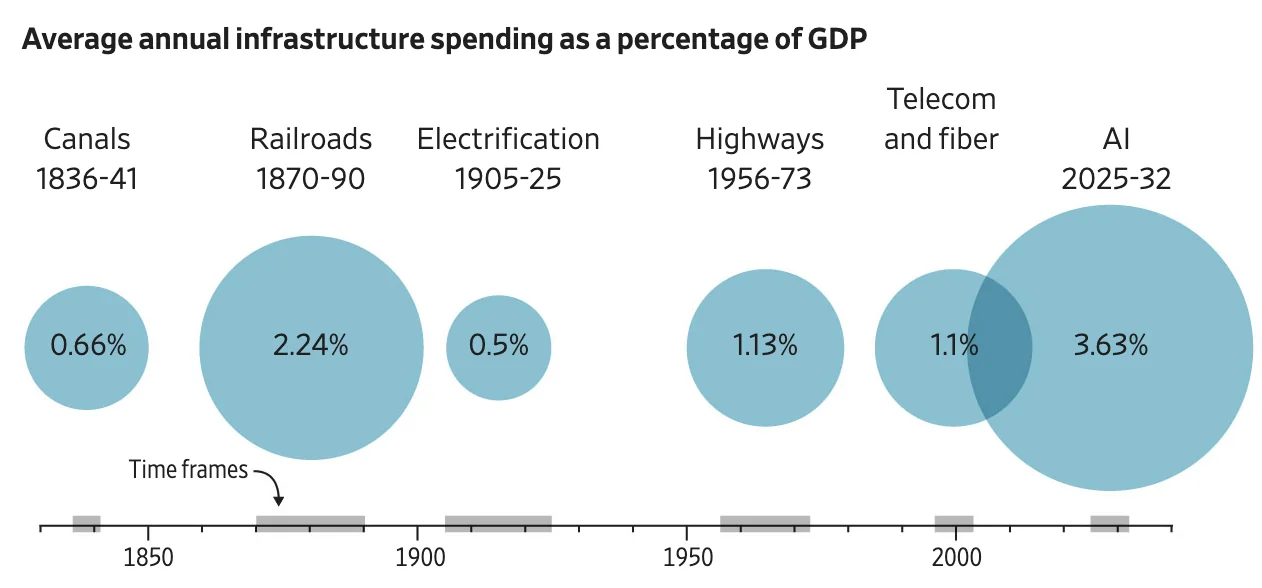
Yet on top of that, economic experts have now concluded this current buildout is bigger than the railroad booms of the 1800s, the highway construction of the 1950s, and even the original internet buildout of the late 1990s.
But what most don’t know is that this ongoing boom also presents a unique opportunity for those who invest in gold.
“Data-center spending is greater than that for the canals, railroads and grid combined… The AI build-out is on track to become the biggest economic bet in U.S. history.”
– Wall Street Journal
Trillions Are Being Spent On The AI Data Center Boom
When you zoom out, the scale of what’s happening right now becomes genuinely hard to wrap your head around.
According to new estimates from economist Stijn van Nieuwerburgh at Columbia University, total U.S. investment in data centers and AI infrastructure is projected to hit $10.3 trillion from 2025 to 2032.
To put that in perspective, that represents an average of 3.63% of U.S. GDP every single year for nearly a decade.
For context:
- That’s roughly 5 times bigger than the electrification boom that wired the nation in the early 1900s.
- 3 times bigger than the construction boom that created the interstate highways.
- And bigger even than the railroad construction boom that created the Robber Barons of the 1800s.
In fact, Goldman Sachs projects AI investment will hit 1.9% of U.S. GDP in 2026 alone.
That’s the largest share of the economy ever devoted to a single new industry since the railroad era of the late 19th century.
And this boom is already transforming entire regions of the country.
Texas, for one, has become ground zero. The Lone Star State now hosts more than 340 data centers, with another 160-plus in development. The Dallas-Fort Worth metroplex alone has more data center capacity under construction than almost any other market in the world.
The same story is playing out across the Midwest – in Iowa, Ohio, Indiana, and Nebraska – where cheap land and available power have turned cornfields into construction sites almost overnight.
But while everyone remains focused on the electricity, the land, and the controversy behind this build-out, a far quieter development is unfolding inside these facilities.
The actual hardware inside these behemoths – the servers, the chips, the connectors, the high-speed networking equipment – requires materials that most investors never associate with technology.
Materials like gold.
“Gold is becoming increasingly important as the AI industry expands, and rising prices are not slowing its use.”
– Fox News
This AI Buildout Is Good News For Gold
Now, most Americans think of gold as jewelry, coins, or bars stored in a vault.
But gold has a second life – as an industrial metal essential to high-performance electronics.
And according to Fox News, the AI boom is creating an entirely new source of demand for physical gold:
“The buildout of artificial intelligence is driving investment in advanced semiconductors, servers and the sprawling data centers needed to power the technology. That expansion also requires a range of materials used in high-performance electronics, including gold.”
– Fox News
Here is why gold is irreplaceable in AI hardware:
1. Conductivity and Reliability
Gold is one of the most conductive and corrosion-resistant metals on Earth. Unlike copper or silver, it does not oxidize or degrade over time. For mission-critical systems that must run 24/7 with zero tolerance for failure, that matters enormously.
2. High-Speed Signal Integrity
As you can imagine, AI data centers move staggering amounts of data at incredible speeds. Gold-plated connectors and contacts ensure signal integrity at frequencies where cheaper materials would degrade performance and cause unforgivable errors.
3. Heat Resistance
Gold’s thermal properties make it valuable in chip production and heat conduction. As a result, it’s become critical in the densely packed, heat-intensive environment of an AI server rack.
Now, given that gold prices have more than doubled since ChatGPT first made waves in 2023, you might assume AI companies would be racing to replace it.
The opposite is happening.
As Joseph Cavatoni, senior market strategist for North America at the World Gold Council, recently explained to Fox News, tech companies are not switching away from gold despite its record prices:
“They might pioneer a technology with gold involved and then say, ‘Let’s find something cheaper like tungsten to replace it.’ But what we’re finding in this case is they’re not.”
– Joseph Cavatoni, World Gold Council
That is a crucial observation.
Normally, when a commodity gets expensive, manufacturers find substitutes. That’s Econ 101, right?
But in AI hardware, the performance requirements are so extreme that gold remains non-negotiable.
As Cavatoni put it:
“This is a rapidly growing space that’s less sensitive to price. It’s going to likely continue to grow as the AI space grows.”
And the numbers back this up.
According to the World Gold Council, gold demand from the technology sector rose to 80.4 metric tons in the second quarter. Electronics demand specifically climbed to 68.3 tons – driven by AI infrastructure, high-end semiconductors, and advanced components.
And here is the thing.
That 68 tons of new demand is growing at the same time that other gold demand sources are setting records.
Demand For Gold Is At An All-Time High
Right now, 4 massive demand engines are firing at once. And the market has not yet priced in the combined effect.
1. Central Banks Are Buying Gold at Record Pace
For 3 consecutive years – 2022, 2023, and 2024 – central banks across the world bought more than 1,000 metric tons of gold annually.
That is the fastest sustained central bank buying spree since the 1970s – which, as you may remember, was also the last time the world faced a major energy crisis.
China, Poland, India, Turkey, Singapore, and dozens of other nations are systematically reducing their dollar exposure and replacing it with gold.
This is not a short-term trade. It is a structural shift that could take decades to fully play out.
2. De-Dollarization and Hedging Against Inflation
After the U.S. froze Russian dollar reserves in 2022, central banks around the world got a wake-up call: any country could be next.
The result has been a slow but relentless move away from dollar-denominated reserves and toward gold.
Meanwhile, the AI buildout itself is inflationary. The Wall Street Journal notes that data-center investment is pushing up wages, increasing demand for scarce materials, and even contributing to higher long-term interest rates as hyperscalers borrow hundreds of billions to fund construction.
Gold has always been the ultimate hedge against that kind of monetary uncertainty.
3. Constrained Mine Supply
Here is the problem with gold supply: it takes 10 to 15 years to bring a new mine online.
And despite gold prices near record highs, global mine production has been essentially flat for nearly a decade.
That is because the easy gold has already been found and extracted. The remaining deposits are deeper, lower-grade, and more expensive to extract.
Environmental and regulatory hurdles add years to any new project.
The net effect: gold supply is effectively capped, no matter how high prices go.
4. A New Industrial Demand Driver from AI Hardware
Now add the data center boom to the equation.
Electronics demand hit 68.3 tons in the second quarter and is growing.
To put that in perspective, central banks bought 63 tons of gold in September 2026.
That single month of central bank buying nearly equals an entire quarter of AI-related electronics demand.
In other words, the AI sector is creating demand for gold that exceeds that from central banks.
That said, the market is still pricing gold as a monetary metal with cyclical spikes in jewelry demand.
It has not fully absorbed the idea that gold is now also a technology metal – with demand growth from an industry that is set to spend $10.3 trillion over the next few years.
When the market wakes up to that reality, the repricing could be meteoric.
Here’s How To Take Advantage With A Gold IRA
Most Americans have the bulk of their retirement savings in a 401(k) or traditional IRA. And most of those accounts are invested in paper assets that are directly exposed to market volatility.
A Gold IRA allows you to hold physical, IRS-approved gold coins and bars inside a self-directed retirement account.
That means:
- You own actual physical gold.
- You get the same tax advantages as a traditional or Roth IRA – either tax-deferred growth or tax-free withdrawals.
- Your retirement savings gain direct exposure to the gold supply-demand mismatch described in this article.
And the process itself is straightforward:
- Open a self-directed IRA with an approved custodian.
- Fund the account by rolling over a portion of your existing 401(k) or IRA, tax-free and penalty-free when done correctly.
- Select your gold from IRS-approved coins and bars.
- Store it in an approved, insured depository.
The AI buildout is the biggest economic bet in U.S. history.
And for those who want to take advantage of it without the volatility of paper assets, a Gold IRA offers a powerful way to benefit from it.
How Orion Can Help
For readers who want to move beyond general information and understand exactly how a Gold IRA would work for their specific situation, Orion Metal Exchange offers an in-house IRA department.
Their team can explain precious metals services and coordinate transactions with custodians and depositories. Contact Orion to discuss the metals-related assistance available for an existing account. The custodian handles distribution processing; qualified tax and legal professionals should review the beneficiary’s obligations and personal decisions.
Have your most recent account statement and a list of unanswered questions ready. The goal of this discussion is to walk away knowing exactly what happens next and who is in charge of getting it done.
Important Disclosure
This article is for educational and informational purposes only. It does not constitute tax, legal, accounting, financial, investment, or trading advice, or a recommendation to buy, sell, or hold any precious metal or other product. Orion Metal Exchange does not provide financial or tax advice.
Precious metals can fluctuate significantly in value and can be volatile. Past performance does not guarantee future results. IRA and tax rules can change and vary with individual circumstances. Consult qualified financial and legal professionals as appropriate. Consult your tax advisor regarding your individual circumstances.