

Experts now predict that the United States will cross a historic threshold this fall, surpassing $40 trillion in national debt for the first time. It will be the largest debt burden carried by any nation, both in absolute dollars and in recorded history.
The U.S. national debt is the cumulative result of decades of federal budget deficits. It includes both debt held by the public and intragovernmental debt or funds borrowed between federal agencies. This ignominious milestone is more than symbolic. It has far-reaching implications for the nation’s fiscal health, economic growth projections, interest rate policy, inflation levels, tax policy, and the long-term sustainability of programs such as Social Security and Medicare.
The Runaway Debt Train
It has been 25 years since America had a balanced budget, and we now find ourselves with one of the most massive deficits in our history. When government spending dramatically outpaces federal revenue, big deficits follow. But to experts, this is far more than a dollars and cents problem. It’s an existential threat and little is being done to address it.
“The greatest threat to our future is hidden in plain sight. It is discussed by economists, fiscal experts, scholars and government officials, yet it barely registers with most voters. The danger is our ever-expanding national debt, which grows larger every year while Washington takes no meaningful action … The experts recognize the danger. The numbers confirm it. Yet elected officials continue spending trillions of dollars annually we do not have, as though there will never be consequences.”[1]
Addressing sovereign debt is politically unpopular because the solution requires a re-balancing of the money coming into the federal coffers versus the money going out and that means raising taxes or cutting federal programs. And according to The Christian Science Monitor, both parties are guilty of exacerbating the problem.
“Today’s Republican Party, dominated by President Donald Trump’s populist brand, reflects his preference for tax cuts and government spending, which he insists will spur economic growth. On the Democratic side, the rise of the left – including adherents of democratic socialism – has also boosted policy goals that would entail massive new government spending, such as ‘Medicare for all.’”[2]
Republicans and Democrats alike want to win elections, avoid political risk, exert party control, and above all, avoid voter backlash. As Jim Nowlan of the Chicago Tribune put it, “Balancing the budget is complicated and difficult. The pressures are to spend more (Democrats) and cut taxes (Republicans). The math does not work.”[3]
And the federal debt us not only growing faster than the U.S. economy but the interest on that debt is now over a trillion dollars a year … higher than our annual national defense budget.
How We Got So Much in the Red
Clearly, we did not get here overnight. The budget surpluses of the late 1990s were fueled by the internet boom, which generated an extraordinary surge in capital gains, corporate profits, and federal tax revenues. But when the dot-com bubble burst in 2000, those revenues evaporated almost as quickly as they appeared. The economy slipped into recession, and wiped out any surplus. The September 11th attacks and ‘the war on terror’ that followed accelerated America’s return to chronic deficit spending.
“Shortly after the 1990s ended, the same two factors that had accidentally balanced the budget—an absence of powerful global adversaries and an aggressive tax revenue bubble—reversed course and unbalanced it. In 2000, the stock market bubble burst because any of the technology companies commanding enormous valuations couldn’t generate profits to justify them. The Nasdaq began a freefall that ultimately reached 77 percent. In early 2001 the economy fell into recession, erasing the earlier tax revenue surge. Then the September 11, 2001 attacks prompted a reversal of earlier defense reductions.”[4]
The tax cuts, increased military spending, and the economic slowdown of the 2000s fueled the national debt, and it continued to increase every year leading up to the subprime mortgage collapse. From 2008 to 2012 America’s gross federal debt surged by a staggering $6 trillion due to the unprecedented bank bailouts and economic stimulus of the Great Recession … jumping from $10.02 trillion in 2008 to $16.06 trillion by 2012.[5]
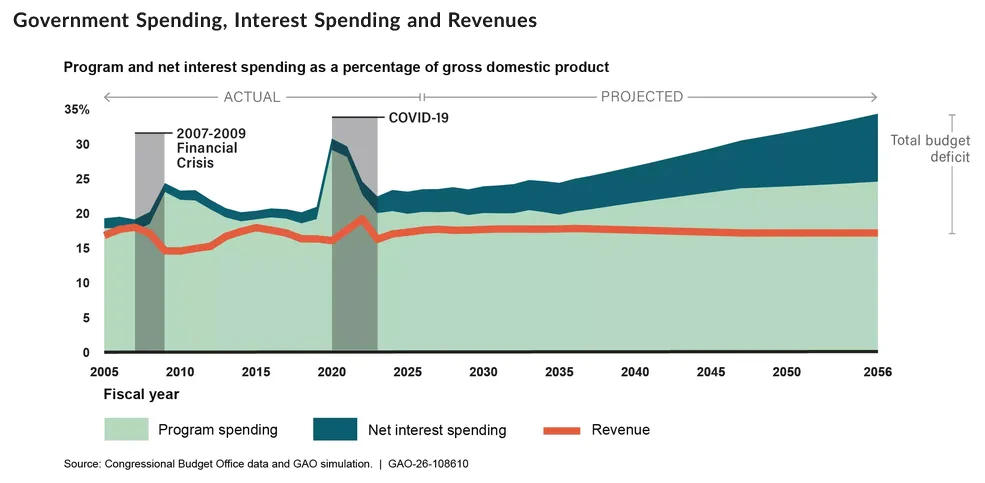
The Great Recession was the single largest driver of rising national debt until the onset of COVID-19. The pandemic-fueled tax relief, monetary easing, quantitative easing, direct lending, small business loans, and stimulus programs increased federal spending by about 50%. At the same time tax revenue dramatically decreased due to business closures, work stoppage and widespread unemployment.[6]
Dreams Denied?
In addition to the cost of wars, recessions and pandemics is the reality of an aging population. The American people are getting dramatically older, and this shrinks the revenue-generating workforce while increasing pressure on costly healthcare programs, public pensions, entitlement spending and social safety nets … placing even greater strain on the federal budget.
“As the working-age population shrinks, economic output growth will slow. Rising old-age dependency ratios and a burgeoning population of elderly will present a growing challenge to finance old-age related entitlements. Governments risk facing unsustainable deficits to support retirees, as spending needs continue to rise and tax revenues decline. Households will be required to shoulder more retirement costs to offset the limited capacity of governments to bear the burden … Policymakers face tough choices balancing budgets amid slower growth.”[7]
The social and economic impact of an aging population will not only affect how we live but also the purchasing power of our money. And for those nearing or in retirement, our mounting federal debt strikes much closer to home than many realize.
A government burdened by heavy debt and deep deficits has few options. It can cut spending, raise taxes, borrow even more or make other difficult tradeoffs.
“The inescapable reality is that America must choose where to focus its government resources. It cannot eventually allocate 21 percent of GDP to benefits for senior citizens (the CBO-projected figure for 2051 when including resulting interest costs), finance even a modest military, and still have significant budgetary resources remaining for social spending, education, and low-income families. To govern is to choose.”[8]
Higher federal debt also pushes interest rates higher, increasing the cost of mortgages, car loans, credit cards, and business borrowing. For retirees, however, the greater concern is inflation. As the government borrows more to finance persistent deficits, it can create inflationary pressures that drive up the cost of everyday goods and services. Over time, inflation erodes the purchasing power of savings, pensions, and fixed-income investments, meaning a retirement income that seems comfortable today may buy considerably less just a few years from now.
 America’s $40 trillion debt is far more than another big government milestone. It reflects decades of borrowing that impact fiscal policy, economic growth, financial security and the prosperity of every American.
But for older Americans, the stakes are particularly high. Retirees have less time to recover from inflation, market corrections, rising taxes or sudden changes to government programs.
While no single investment can eliminate these risks, many investors choose to diversify their portfolios with tangible assets like physical gold and silver which have historically held their value and helped preserve purchasing power during periods of rising prices, a weak dollar and broader economic uncertainty.
“Whenever the government taxes, spends or creates inflation through printing money, it offers an incentive for resources to leave good investments and chase bad ones … The federal debt is a ledger of opportunities lost and dreams denied. It is part of the financial footprint left behind by the government’s redirection and mostly misdirection of Americans’ talent, effort and energy.”[9]
Chart Sources:
https://taxpolicycenter.org/taxvox/how-did-budget-get-balanced-late-1990s
https://www.gao.gov/blog/federal-governments-debt-growing-faster-than-economy-what-means-for-you
https://www.urban.org/policy-centers/cross-center-initiatives/program-retirement-policy/projects/data-warehouse/what-future-holds/us-population-aging
ORION METAL EXCHANGE is a Leading Precious Metals Dealer
With Live Pricing, Low Commissions and Top-Rated CUSTOMER SERVICE.
Call Now for a FREE Investor Kit!
REPRESENTATIVES ARE AVAILABLE NOW AT: 1-800-559-0088
1 https://www.foxnews.com/opinion/john-adams-made-terrifying-prediction-america-close-proving-him-correct
2 https://www.csmonitor.com/USA/Politics/2026/0727/debt-deficit-congress-spending
3 https://www.union-bulletin.com/opinion/opinion_columns/commentary-politicians-seem-incapable-of-balancing-the-federal-budget/article_4e215181-075b-4f63-a267-7f714d9daf08.html
4 https://taxpolicycenter.org/taxvox/how-did-budget-get-balanced-late-1990s
5 https://www.cbo.gov/publication/45555
6 https://fiscaldata.treasury.gov/americas-finance-guide/national-debt/
7 https://www.westernasset.com/us/en/research/whitepapers/aging-populations-and-growing-public-debt-burdens.cfm
8 https://www.pgpf.org/programs-and-projects/convening-experts/expert-views/americas-fiscal-and-economic-outlook/fix-social-security-and-medicare-to-protect-other-priorities/
9 https://www.heritage.org/debt/commentary/national-debt-burden-every-american