One of America’s most beloved presidents, Ronald Reagan, believed inflation was one of worst of all economic evils. He called it “the enemy of the people” and famously quipped that it’s “as violent as a mugger, as frightening as an armed robber and as deadly as a hit man.”[1]
Reagan’s warning was purposely forceful because inflation is much more than rising prices. It’s a destructive force that devalues paper currencies, squeezes profit margins, increases interest rates, reduces earnings, and slows economic growth.
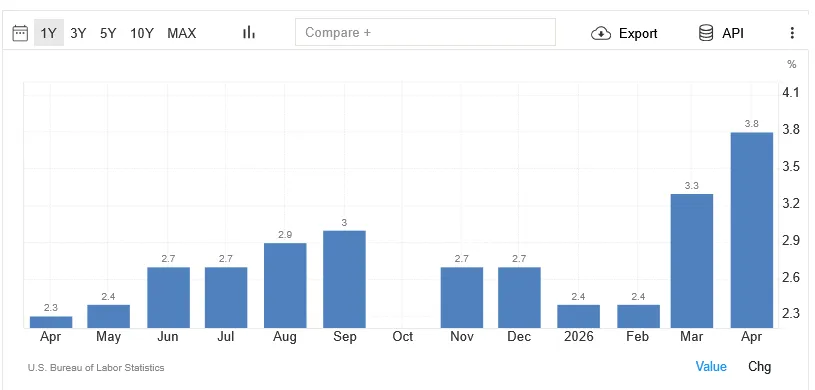 Our ongoing war with Iran and the continued tussle over the Strait of Hormuz have triggered a massive energy price shock that has spilled over into consumer goods, food, wages, travel, and manufacturing. The year-over-year inflation rate has now climbed to 3.8%[2], the highest level since 2023[3] with no relief in sight. This will likely create a rush to stores of value and tangible assets like gold and silver.
The ‘Triple Threat’ of Inflation
Ronald Reagan understood one thing very clearly; inflation destroys wealth and erodes savings accounts. He considered it a tax levied on your money without an explicit legislative action. He also understood how quickly it can undermine critical retirement income.
According to a recent MarketWatch report, inflation can create a vicious cycle for retirees living on fixed income.
“For retirees, inflation can hit especially hard thanks to three factors that interact with these rising costs: increased withdrawals, taxes, and how those parlay into depleting savings,” said Jay Sharifi, CEO of Legacy Wealth Management.
MarketWatch noted that inflation may force retirees to take larger withdrawals to cover living expenses, potentially increasing tax burdens and accelerating portfolio depletion.[4]
An equally destructive threat is inflation’s impact on the future real value of your investments, assets and/or income streams. In other words, anything dominated by paper is vulnerable to inflationary risk because it will lose value in direct proportion to the decline in the purchasing power of money.[5]
From Wealth Erosion to Portfolio Preservation
Unlike a market crash, a housing bust, or a punishing recession — inflation is quiet. It is a stealth erosion of financial security, and it moves silently and imperceptibly similar to how poet Carl Sandberg described fog, “on little cat feet … looking over harbor and city on silent haunches.”[6] Inflation is at once pervasive and invasive which is why it’s often called the silent wealth killer.
JPMorgan Chase recently compared today’s risks to the inflation crisis of the 1970s, when the S&P 500 lost roughly one-third of its value (between 1970 and 1974) and the dollar’s purchasing power sharply declined. In a recent story by Yahoo Finance, the bank warned that inflation could become dangerously embedded and even normalized.
“As another one-off economic shock unfolds in the post-COVID era, we continue to believe inflation’s floor is higher than it was before the pandemic and that the correlation between stocks and bonds could now be structurally higher. Rolling shocks may be the new reality … An unsettling lesson from the 1970s, and a risk today, is that price shocks can become quickly normalized when they occur in rapid succession.”[7]
What does this mean for retirement investors? It means that the traditional assumptions about portfolio allocation and long-term financial security may no longer be enough to protect your money in a world where inflation shocks are unexpected, more frequent, and becoming more deeply ingrained in the economy.
In inflationary environments where purchasing power is steadily eroded, investors have historically turned to gold as a tool for wealth preservation. As Ray Dalio, the founder of the world’s largest and most successful hedge funds has said numerous times, “If you don’t own gold, you neither know history, nor economics.”
An Inflation Fueled Gold Run
In simple terms, when inflation devalues the dollar, it takes more dollars to buy an ounce of gold. But that’s only part of the inflation story. If inflation rises faster than interest rates or the rate of return on a savings account, bonds or CDs — gold becomes more attractive. Inflation also triggers safe haven demand for gold which is recognized as a universal store of value.
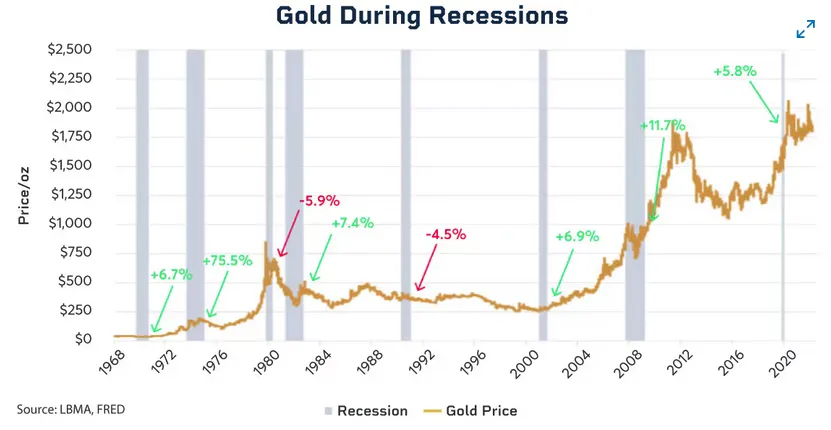 According to CME Group, the world’s largest derivative marketplace, gold prices have historically surged during financial upheavals and economic downturns.
“There have been eight recessions between 1973 and the most recent in 2020. In all but two of these, gold has outperformed the S&P 500 … Gold also benefits from the overall increase of money in the system, particularly when weakness in the underlying economy acts as an impediment to investing in economically sensitive stocks. 2008’s Great Financial Crisis was a perfect example. The Federal Reserve cut the funds rate from 4.75% in late 2007 to essentially 0% by 2009 and left rates near zero for the next six years. Gold prices rallied almost 50% during the period.”[8]
Gold demand is also being driven by central bank purchases, soaring debt burdens, and geopolitical risk all of which are currently running at historic highs. Add a cooling economy, a struggling U.S. consumer, and rising concerns over long-term purchasing power – and we have a recipe for another inflation-fueled gold run.
Gold investors view the precious metal as critical portfolio protection because it provides diversification against market swings, volatility, and the erosion of dollar-backed holdings.
 And according to Investopedia, gold’s allure as a strategic wealth preservation tool is more solid than ever.
“Gold’s role as a safe-haven asset has become more pronounced in an increasingly interconnected global economy. Events like the 2008 financial crisis, the pandemic, and geopolitical conflicts have demonstrated how quickly investors can flock to gold during times of uncertainty.”[9]
And that’s precisely why so many gold investors are smiling today. In an era defined by inflation, instability, and uncertainty … gold continues to provide something increasingly difficult to find: financial peace of mind.
ORION METAL EXCHANGE is a top-rated
GOLD IRA DEALER with Best-in-Class CUSTOMER SERVICE.
Call for a FREE Investor Kit and up to $30K in FREE metals (on qualifying purchases).
REPRESENTATIVES ARE AVAILABLE NOW AT: 1-800-559-0088
1 https://www.brainyquote.com/quotes/ronald_reagan_125910
2 https://tradingeconomics.com/united-states/inflation-cpi
3 https://www.cnbc.com/2026/05/12/cpi-inflation-april-2026-.html
4 https://www.marketwatch.com/picks/inflation-is-at-a-3-year-high-this-is-the-triple-threat-that-retirees-now-face-because-of-it-c781c9f0
5 https://www.investopedia.com/terms/i/inflationrisk.asp
6 https://www.poetryfoundation.org/poems/45032/fog-56d2245d7b36c
7 https://finance.yahoo.com/economy/policy/articles/jpmorgan-warns-investors-silent-risk-182716623.html
8 https://www.cmegroup.com/openmarkets/metals/2023/How-Does-Gold-Perform-with-Inflation-Stagflation-and-Recession.html
9 https://www.investopedia.com/ask/answers/020915/has-gold-been-good-investment-over-long-term.asp