
Some of Wall Street’s most respected voices are warning about an imminent double digit stock market drop. Big banks like Goldman Sachs and Morgan Stanley are raising the alarm bells about a significant pullback in equities due to overstretched valuations, an expanding AI bubble, irrational exuberance, and any number of external shocks. One report expressly compared the market to a giant game of Jenga where the investments of countless Americans could be toppled by a single “economic peg” including global instability, a high inflation reading, dismal employment data, a sudden policy shift and panicked selling.
The Jenga Comparative

The game of Jenga was invented in the 1970’s by a woman in Ghana. The name comes from the Swahili word kujenga which means ‘to build.’ It is game of skill based on the fairly simple premise of building and stacking blocks. Players take turns removing a smooth wooden peg from a stacked tower and then try to balance it back on top of the tower, creating a taller and increasingly unstable structure as the game progresses.[1]
It is perhaps the perfect metaphor for Wall Street in the age of high capital expenditures, fast moving technologies, ultra-high market concentrations and still dubious returns.
“One of the many great scenes in The Big Short, which fictionalizes famed investor Michael Burry’s bet against the U.S. housing market, involves a tower of wooden blocks. During a client pitch, a trader illustrating the risk of collateralized debt obligations unveils a Jenga tower that represents the mortgage bonds stuffed inside a CDO. It inevitably collapses, of course, both on screen and in real life. A lot of skeptical investors are waiting for a similar implosion of the artificial-intelligence investment boom.”[2]
The experts are clear — Wall Street valuations are highly stretched, speculation is rampant, and fear-of-missing-out is at a fever pitch. Experts are now warning that we have built an extremely top heavy, unstable, and unbalanced stock market abomination.
The Infamous P/E Ratio is Screaming
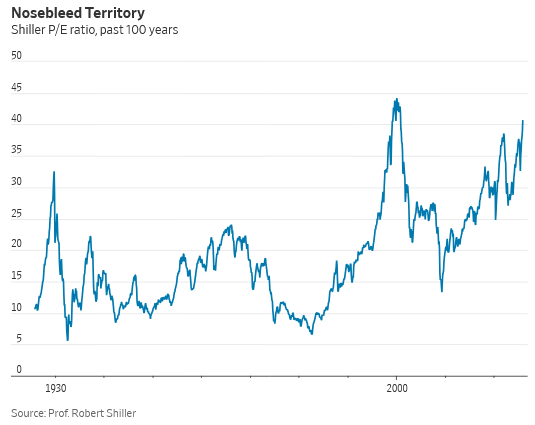
One of the market measures that garners a lot of attention is Robert Shiller’s P/E ratio or the ‘Cyclically Adjusted Price-to-Earnings’ (CAPE) ratio. Shiller is an American economist who won the Nobel Prize in Economic Sciences in 2013 for his work in behavioral economics. His P/E ratio measures a company’s share price relative to its earnings per share (EPS) and helps assess the comparative value of a company’s stock.[3]
The current P/E ratio is currently very high. As a matter of fact, it’s in what the Wall Street Journal is calling “nosebleed territory,” and could be a sobering indicator about coming volatility, lower returns, and some very rough days ahead for the U.S. stock market.
Considered the ‘gold standard’ of valuation, the P/E ratio provides a comprehensive view of equity indexes and particularly whether stock prices are over or under valued.
“The version popularized by Nobel Prize-winning economist Robert Shiller looks back at 10 years of earnings and adjusts them for inflation to cover an entire business cycle. It recently broke above 40 for the second time ever. The first was in 1999, and it didn’t stay there long. Cyclical peaks in the Shiller P/E have coincided with negative real (inflation-adjusted) returns for stocks over the ensuing 10 years, including in 1929, 1966 and 2000.”[4]
Market Bubbles and the Case for Gold
The current Shiller P/E ratio is at 40x — while the historical average over the past 140 years is just 17x. This suggests that Wall Street is trading at twice its historical average valuation, a level not seen since the dot.com days. And this translates to a massive market bubble.

A “bubble” is really an insufficient phrase for current stock valuation risk. Market bubbles not only tend to precede an inevitable implosion, they also have the capacity to catch investors off guard, decimating their nest eggs. And the current AI bubble has the potential to be catastrophic.
According to David Solomon, the CEO of Goldman Sachs:
“When you have these cycles, things can run for a period of time. But there are things that will change sentiment and will create drawdowns, or change the perspective on the growth trajectory, and none of us are smart enough to see them until they actually occur.”[5]
Consider this … Among the 10 largest companies in the S&P 500, the AI theme is heavily represented in names like Nvidia Corp. (NVDA), Meta Platforms Inc. (META), Broadcom Inc. (AVGO), Microsoft Corp. (MSFT), Amazon.com Inc. (AMZN), Alphabet Inc. – which is counted twice by RBC due to its dual share classes, Class A (GOOGL) and Class C (GOOG) – Apple Inc. (AAPL) and Tesla Inc. (TSLA).[6]

Gold, of course, is not tied to corporate earnings, stock values, or Wall Street exuberance. It has a low correlation to equities and boasts long-standing intrinsic value. Most importantly, it is a hedge against market chaos and bubble fallout. Let’s not forget, gold protected accrued wealth during the dot.com crash, the 2008 financial crisis, and the recent Covid-19 bubble.
And in terms of your investments, gold is the sturdy, tangible and stabilizing block that can secure the structure and integrity of your retirement portfolio.
This article was brought to you by ORION METAL EXCHANGE,
a top-rated PRECIOUS METALS DEALER with
Best-in-Class CUSTOMER SERVICE.
Get a FREE Investor Kit and up to $30,000 in FREE metals (on qualifying purchases).
REPRESENTATIVES ARE AVAILABLE NOW AT: 1-800-559-0088
[1] https://www.jenga.com/about.php
[2] https://www.barrons.com/articles/ai-capex-debt-spv-6346025a?mod=hp_LEDE_C_1
[3] https://www.investopedia.com/terms/p/price-earningsratio.asp#toc-pe-ratio-formula-and-calculation
[4] https://www.wsj.com/finance/investing/this-famous-method-of-valuing-stocks-is-pointing-toward-some-rough-years-ahead-4eb6a498?
[5] https://www.reuters.com/business/finance/morgan-stanley-ceo-warns-market-heading-towards-correction-2025-11-04/
[6] https://www.morningstar.com/news/marketwatch/20251103334/this-chart-shows-the-risk-of-an-ai-bubble-is-growing-says-a-stalwart-stock-market-bull