
You’ve seen all of the headlines … gold is either up on market volatility or pulling back on profit-taking. It is rising on Middle East uncertainty or under pressure by a resilient dollar. But the quieter story is the unprecedented and record-breaking accumulation of gold by the world’s reserve banks. Central banks acquired 41 tons of gold in May alone, continuing a buying spree not seen in generations. Does this reflect a profound loss of trust in fiat money, concerns about the value of the dollar, or worries about economic sanctions?
Perhaps it’s something else entirely. Over the past four years the world’s monetary authorities have acquired an average of 1,000 metric tons of gold every single year. That’s double the pace of the previous decade. So, what do Poland, China, Russia, and Uzbekistan know that perhaps the rest of us don’t?
The Bank of the Banks
 The world’s central bankers have their hands on the levers of monetary policy and borrowing costs. They can finance debt, orchestrate bailouts, and print money out of thin air. Central banks hold considerable global power to tame inflation, rescue economies and even trigger recessions. The World Economic Forum calls them “The Guardians of Stability” and touts their role in preserving purchasing power.
“Despite the growing list of challenges confronting central banks, one principle remains unchanged: price stability is key … The primary tool central banks deploy is the adjustment of interest rates, which influence borrowing, spending and inflation across an economy. Central banks can also buy and sell government securities, adjust government reserve holding requirements and enact quantitative easing and tightening measures.”[1]
These global custodians of sound money, however, are buying up gold at a rate that is historically unprecedented. They are not increasing their holdings of dollars, foreign currencies or bitcoin at record levels. Instead, they are loading up on a rare metal with intrinsic value that has been around for thousands of years.
To put global gold demand in perspective, central banks are buying gold equal to roughly 2.6 million 1-ounce bars every single month. While they actually purchase gold in massive institutional blocks, their volume is the equivalent of a consumer retail bar being hoarded every single second.
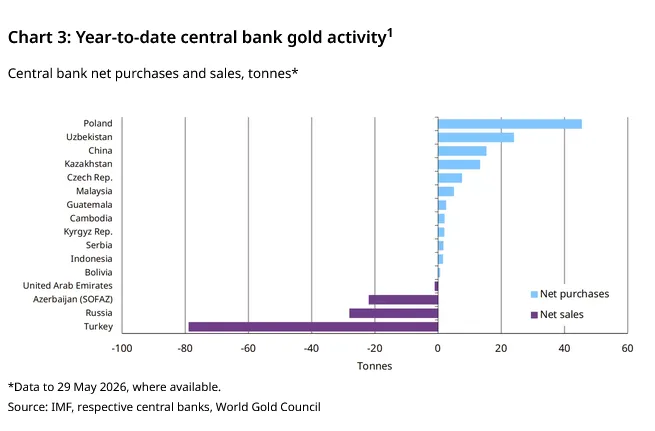
According to the World Gold Council’s June update, Poland was the month’s largest buyer, with gold now accounting for 30% of its total reserves. Uzbekistan followed, holding an impressive 88% of its reserves in gold. Meanwhile, China has accelerated its buying spree, extending its streak to 18 consecutive months.[2]
While investors remain focused on Fed policy, earning reports, and stock market headlines, one of the biggest shifts in the global financial system is unfolding with remarkably little public discussion.
The Big Story on the Cutting Room Floor
 Many central banks are looking to diversify away from the greenback due to U.S. government debt concerns, dollar weaponization, and general reserve balancing. U.S. debt is now approaching a staggering $40 trillion with soaring interest costs creating a vicious cycle of budget shortfalls, deficits, and money printing that threaten to devalue the greenback.
The dollar has also been used as a tool of economic sanctions which has prompted foreign nations to consciously de-dollarize. Subsequently, worldwide demand for U.S. treasuries has dropped while demand for sanction-free gold continues to rise.
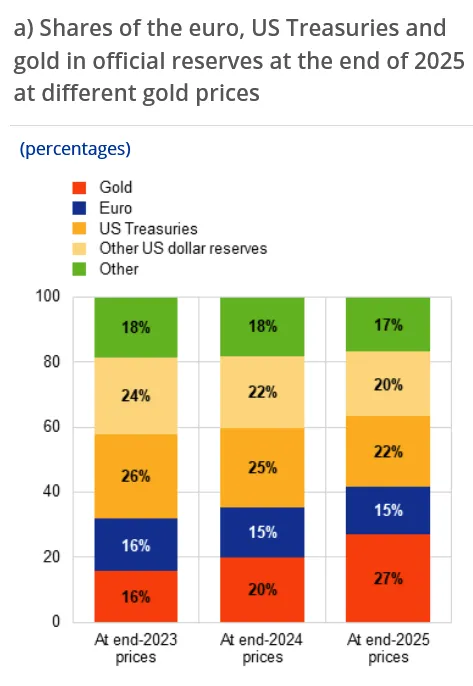
The European Central Bank’s June report, summarizes this dramatic shift in global reserves.
“The share of gold in total official foreign reserves comprising both foreign exchange and gold holdings – had increased to 27% at the end of 2025. The share of gold now surpasses both that of the euro (15%) and U.S. Treasuries (22%).”[3]
This marks the first time in roughly three decades that gold has become the largest component of global official reserves, surpassing U.S. Treasuries. Heretofore, U.S. government bonds have dominated modern financial reserves because of their liquidity, safety, and central role in the dollar-based system.[4]
 Lastly, the world’s central banks look to gold for portfolio protection, balance, and stability. Gold not only moves independently of traditional assets like stocks, bonds, and government securities — it also helps shield economies from the inherent volatility of paper assets. Unlike fiat money, gold’s value does not depend on another nation’s fiscal health, monetary policy, or political stability. Instead, it has served as a trusted store of value for thousands of years, preserving purchasing power through wars, recessions, pandemics, currency crises, and economic upheavals.
“Despite its antiquity, gold is still a useful and robust component of a central bank’s portfolio, and holdings in many central banks are far from static. Reserve managers’ allocation decisions regarding gold depend on a myriad of factors including policy objectives, risk tolerance, costs and the like – but bullion’s status appears rock solid. As the global economy continues to evolve, economic and geopolitical uncertainties appear to be on the rise, creating an atmosphere where central banks may continue to seek gold.”[5]
The Real Thing
 There is no shortage of financial media fascination with stocks, cryptos, AI startups, and private equity. Meanwhile, more than $13 trillion in global reserves is quietly undergoing an historic realignment.
This isn’t a short-term trade. It’s a structural shift driven by mounting debt, fiscal deterioration, de-dollarization and sustained, multi-year gold accumulation. When the powerful institutions that create money are buying gold, investors should ask why.
Gold may not be flashy, trendy or the next big thing. But to central banks around the world, it is the real thing. And for retirees seeking diversification, inflation protection and long-term wealth preservation, it deserves to be part of a much larger conversation.
ORION METAL EXCHANGE is a Leading Precious Metals Dealer
With Live Pricing, Low Commissions and Top-Rated CUSTOMER SERVICE.
Call Now for a FREE Investor Kit!
REPRESENTATIVES ARE AVAILABLE NOW AT: 1-800-559-0088
1 https://www.weforum.org/stories/financial-and-monetary-systems/role-central-banks-2026-according-central-bankers/
2 https://www.gold.org/goldhub/gold-focus/2026/06/central-bank-gold-statistics-central-banks-resume-net-buying-april
3 https://www.ecb.europa.eu/press/other-publications/ire/html/ecb.ire202606.ro.html
4 https://finance.yahoo.com/markets/commodities/articles/report-reveals-gold-overtaken-u-180925690.html
5 https://www.lbma.org.uk/alchemist/alchemist-110/the-role-of-gold-in-central-bank-reserves