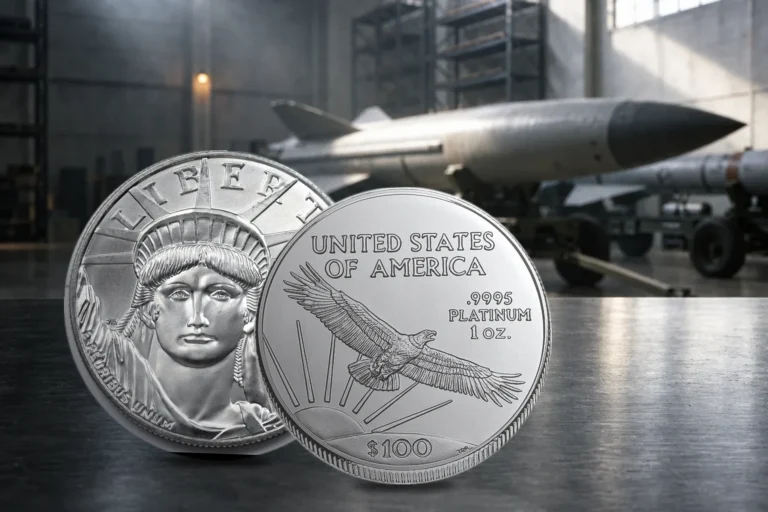

As political risks rise, world alliances fracture, and countries become unstable — gold reacts. It has become the economic bellwether of the modern global economy.
While the stock market tends to turn a blind eye to international turmoil, gold is often the first asset to gauge the financial fallout of geopolitical mayhem. Gold prices respond to trade disruptions, currency stress, market fears, and risks to dollar-dominated reserves around the world.
As a portfolio asset, gold is the beneficiary of uncertainty, volatility and international flashpoints. The recent apprehension of Venezuelan dictator Nicolas Maduro, the nationwide protests in Iran, the ongoing conflict between Russia and Ukraine, and of course persistent tensions between the U.S. and China — are all indicative of geopolitical fragmentation. And in 2026, increasing international instability continues to suggest that gold is underpriced.
America’s Venezuelan Gambit
On January 3, 2026, the United States launched a secret operation to capture disputed Venezuelan president Nicolas Maduro and his wife to bring them to justice in the United States. The pair is accused of collaborating with terrorist groups and drug cartels in the act of committing narcoterrorism.

The move by the U.S. is fraught with risk — from the rise of pro-regime militias, to the cost of a prolonged military operation, to a deepening humanitarian crisis, to increasing tensions with Venezuela’s neighbors.
According to Brookings, the U.S. operation also does not seem to have a clear path to success:
“The U.S. intervention in Venezuela epitomizes the American way of war since 9/11: stunningly effective tactics by special operations forces, dangerously divorced from any coherent story about how they will produce strategic and political success … All of this raises the question of how much policy change on drugs, immigration, and oil—the ostensible motives for the operation—will result from Maduro’s capture. His departure alone certainly will not bring overnight political liberalization or economic recovery, outcomes that at best would be years away even with adequate planning and resources.”[1]
Gold prices surged about 3% in the immediate aftermath of the U.S. military action in Venezuela.
 The 2026 Iranian Uprising
In scenes reminiscent of the 1979 Iranian Revolution, Iran is once again engulfed in anti-government protests. Citizens across all of Iran’s provinces have taken to the streets to demonstrate against high prices, soaring inflation, currency depreciation, and to call for the end of theocratic Islamic rule.
Human rights groups are reporting that thousands have been killed as Iranian authorities engage in a heavy-handed crackdown on demonstrations despite warnings from President Trump that the U.S. will intervene if peaceful protestors are killed.
“Fueled by poverty and sometimes ethnic inequality, crowds chanted ‘Death to Khamenei,’ directly challenging Iran’s supreme leader, Ayatollah Ali Khamenei, who holds ultimate authority over the nation’s religious and state affairs. As of Tuesday, at least 1,850 protesters have been killed, according to US-based Human Rights Activists News Agency (HRANA) … Iranian authorities cut internet and telephone lines the night of January 8 local time. However, people were able to use some landline and mobile phones to call abroad on Tuesday for the first time since the communications blackout took effect.”[2]
Since the latest round of protests, which started on December 28, 2025, gold has gained over $227/oz.
The Ongoing Russo/Ukrainian War
Russia’s full-scale invasion of Ukraine in 2022 destabilized the global economy by disrupting supply chains, triggering food insecurity, driving up energy prices, undermining economic growth and killing hundreds of thousands of people on both sides.
According to the Economics Observatory, the impact of the Russian invasion is far-reaching and has not only destabilized much of Eastern Europe but has also triggered a humanitarian crisis in Ukraine, threatened energy security, and fractured longstanding global alliances.
“Russia’s brutal invasion has driven millions into poverty and debilitated – but not quite destroyed – Ukraine’s economy. Meanwhile, sanctions are straining the Russian economy, but they are yet to end a war that has sown financial turmoil and personal hardship in the region and across the globe. It was clear from the start that Putin’s war in Ukraine would be a global economic disaster. Its economic impacts may be insignificant next to the suffering and loss of life on the battlefields. But they do present critical challenges that leaders must resolve to limit yet more suffering through poverty, food shortages and the cost-of-living crisis.”[3]
Since the start of the Russo-Ukrainian conflict back in February of 2014 that resulted in the annexation of Crimea, the price of gold has risen over 273%.
Delicate U.S. and China Relations

The geopolitical competition between the United States and China is about economic power and global supremacy. There is not only a technological race between the two superpowers, there is a broad trade war, military tensions (particularly with respect to territorial disputes over Taiwan and the South China Sea), and concern about increasing Chinese influence in Latin America and the Caribbean.
While the U.S. and China are not “frenemies,” their relationship is complicated, economically entangled, and in many respects co-dependent.
“The economies of both the U.S. and China follow a system where production is dependent on private capital, international technological transfer and trade in intermediate goods. The roles of these two countries in the whole value chain differ, creating inter-dependencies that are difficult to get rid of. The U.S. is a provider of services, technologies and investment, while China is the factory of the world for merchandise products. This interdependence is particularly evident in the trade relationship between the two countries.”[4]
The rivalry between the two nations is neither temporary nor situational. It is structural and ideological. The United States seeks to preserve its dollar-based economic power and safeguard its national security interests — while China is working to expand its global influence and reduce U.S. dominance within the international monetary system.
For as long as this strategic competition exists, gold will be a vital portfolio asset as China continues to reduce its exposure to the U.S. dollar and increase its central bank gold reserves.
Geopolitics and geoeconomics embody monetary policies, global capital flows, military actions, natural resources, trading partners, foreign policy, government relationships, the global marketplace and political power. And when there’s a geopolitical crisis, the frailty of our economic interdependence and shared vulnerabilities are exposed. Governments collapse, leaders change, alliances shift, money evolves, and conflicts arise — but gold remains a strategic asset due to its intrinsic value and universal appeal.
Every geopolitical crisis is a big gold story because each one exposes the instability of the global financial system — and gold exists outside of it and in many respects because of it.
ORION METAL EXCHANGE is a top-rated
PRECIOUS METALS DEALER with Best-in-Class CUSTOMER SERVICE.
Get a FREE Investor Kit and up to $30,000 in FREE metals (on qualifying purchases).
REPRESENTATIVES ARE AVAILABLE NOW AT: 1-800-559-0088
[1] https://www.brookings.edu/articles/making-sense-of-the-us-military-operation-in-venezuela/
[2] https://www.cnn.com/2026/01/12/middleeast/iran-mass-protests-explained-intl
[3] https://www.economicsobservatory.com/ukraine-whats-the-global-economic-impact-of-russias-invasion
[4] https://thediplomat.com/2025/12/china-us-a-rivalry-too-entangled-to-decouple/