
For many Americans, this has been anything but a banner year. Prices remain stubbornly high, markets are volatile, the Fed appears stuck, and escalating conflict in the Middle East continues to rattle the global economy particularly the energy markets.
The high seas standoff over a 21-mile shipping channel half a world away, is now hitting home and showing up in higher fuel costs, rising household expenses, and growing financial strain. Prominent economists are warning that we may not only be drifting toward a recession but already standing at the edge of a rapidly unfolding downturn.
Fortunately, we’ve seen this before. History draws a clear line between those who prepare and those who don’t. So, it’s not an over-reaction to say that the decisions we make now could ultimately define how much money we protect and how much we lose as the economy unravels.
A Recession by Any Other Name
The tricky thing about recessions is that they’re often only confirmed after we’re already in them. They’re defined using backward-looking data, so by the time the actual “label” is applied, much of the damage to our savings and retirement accounts may already be done.
In general terms, a recession is a decline in economic activity over a period of months and the criteria used to make that determination, i.e. GDP, jobs reports, inflation, income, retail sales, etc., is not only lagging but could also take months to gather, verify, and evaluate.
According to the National Bureau of Economic Research (NBER), officially declaring a recession is a delicate balance of factors:
“The committee’s view is that while each of the three criteria—depth, diffusion, and duration—needs to be met individually to some degree, extreme conditions revealed by one criterion may partially offset weaker indications from another. For example, in the case of the February 2020 peak in economic activity, we concluded that the drop in activity had been so great and so widely diffused throughout the economy that the downturn should be classified as a recession even if it proved to be quite brief. The committee subsequently determined that the trough occurred two months after the peak, in April 2020.” [1]
Suffice to say, for the average investor, recessions are not only widely misunderstood, but also difficult to anticipate and plan for. The key is not perfect timing, but early awareness. So, it’s important to heed warnings, identify your financial stress points, and pressure-test your portfolio before conditions worsen.
The Warnings of 2026
 Highly volatile geopolitical events, stubborn inflation, AI layoffs, surging U.S. debt, and pain at the pump have caused recession chatter to rise this year. But there are other indicators as well.
“The warning sign the stock and bond markets are currently flashing is an ‘un-inversion,’ which occurs when short-term interest rates begin to fall, and the curve returns to its normal upward slope … You can look at the past four recessions and see how the un-inversions have timed up with them. The COVID pandemic caused the 2020 recession, but the un-inversion began in mid-2019; an un-inversion began in early 2007, leading up to the Great Recession; the spread turned positive in the few months leading up to the dot-com bubble in 2001; and it turned positive in late 1989, going into the 1990 recession. You shouldn’t take the current correlation as a sign of doomsday, but rather as a warning sign to prepare accordingly. It’s always better to be overprepared than underprepared.” [2]
Goldman Sachs, Morgan Stanley, Citadel, and the IMF have all increased their odds of a recession. Mark Zandi of Moody’s Analytics, has not only raised the recession alarm, but deemed the threat to be more imminent, particularly as it relates to oil prices.
“I’m concerned recession risks are uncomfortably high and on the rise. Recession is a real threat here. The negative consequences of higher oil prices happen first and fast. If oil prices stay kind of where they are through Memorial Day, certainly through the end of the second quarter, that’ll push us into recession.” [3]
What Investors Should Do
In times like these, it’s important to take action. From bolstering your emergency fund to paying down debt — diversifying your portfolio to hedging Wall Street jitters — most experts suggest a concrete defense strategy is the best way to cushion yourself from the impact of a downturn.
1. Beef Up Your Emergency Savings
Unless you have a small business, the top threat to your finances during a recession is losing your paycheck
2. Keep an Eye on Your Spending and Income
You’re looking to cover the bare minimum in the case of an emergency. To that end, think about which expenses you’d strip from your budget if you were trying to get by between jobs.
3. ‘Buckle Up’ Your Portfolio
By spreading your investments across a wide variety of assets, you help mitigate the risk that a decline in any one position will cripple your portfolio. For many investors, maintaining diversification could mean pruning back positions in riskier assets. [4]
While these defensive moves will help you weather a negative growth environment, true portfolio protection also requires preserving value and protecting wealth. This is where gold, silver, platinum and palladium shine brightest.
 According to startup incubator, Faster Capital, precious metals are a tried-and-true investment during economic contractions and a viable way to safeguard wealth:
Safe-haven Asset: Precious metals are often considered a safe-haven asset that can protect one’s wealth during economic turmoil and inflation.
Diversification: Investing in precious metals can help diversify one’s portfolio and minimize risks.
Inflation hedge: Precious metals have historically been an effective hedge against inflation, as their value tends to rise during times of high inflation.
Long-term Store of Value: Precious metals have proven to be a reliable store of value over time, as their value tends to appreciate over the long term. [5]
The Orion Rule
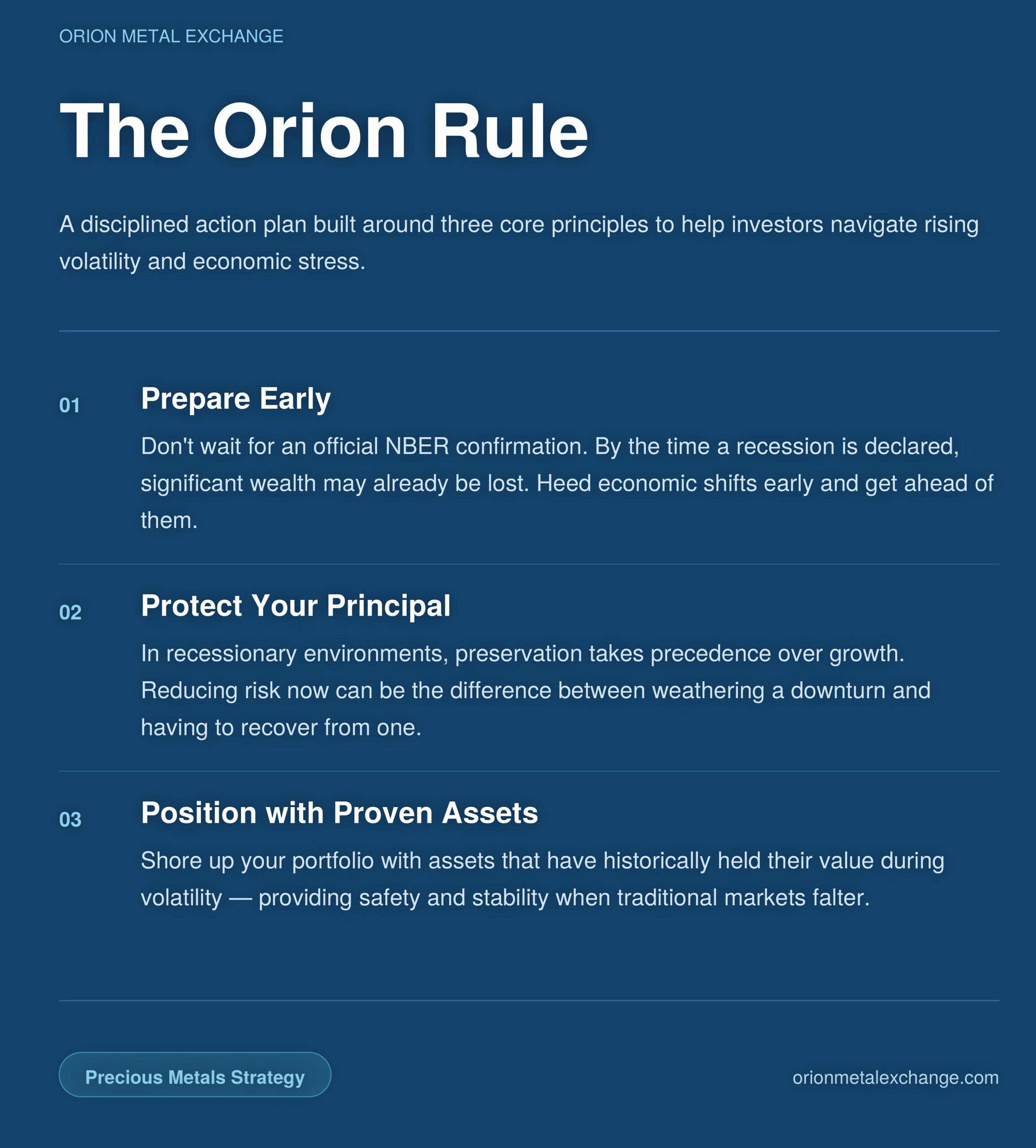
At Orion Metal Exchange, we’ve developed a quick set of guidelines to help investors navigate periods of rising volatility and economic stress. We call it “The Orion Rule,” an easy action plan built around three core principles: Prepare Early, Protect Your Principal, and Position with Proven Assets:
Prepare Early: Don’t wait for an official “recession” confirmation from the NBER. By the time a recession is deemed official, you may have lost a significant amount of wealth. Heed economic shifts early and get ahead of them.
Protect Your Principal: In recessionary environments, preservation takes precedence over growth. Reducing your risk now can be the difference between weathering a downturn and having to recover from one.
Position with Proven Assets: Shore up your portfolio with assets that have historically held their value during periods of volatility to help provide safety and stability when traditional markets falter.
Remember, recessions don’t announce themselves. They arrive quietly and erode wealth surreptitiously. The Orion Rule is your recession playbook. Use it — because what you do next can make or break how much you have left when the dust settles.
ORION METAL EXCHANGE is a top-rated
GOLD IRA DEALER with Best-in-Class CUSTOMER SERVICE.
Call for a FREE Investor Kit and up to $30K in FREE metals (on qualifying purchases).
REPRESENTATIVES ARE AVAILABLE NOW AT: 1-800-559-0088
1. https://www.nber.org/research/business-cycle-dating/business-cycle-dating-procedure-frequently-asked-questions
2. https://www.fool.com/investing/2026/04/14/stock-and-bond-markets-are-flashing-a-warning/
3. https://www.cnbc.com/2026/03/25/recession-odds-climb-on-wall-street-as-economy-shows-cracks-beneath-the-surface.html
4. https://www.cnbc.com/2025/03/14/how-to-recession-proof-your-finances-according-to-cfps.html
5. https://fastercapital.com/content/Precious-Metals–Preserving-Wealth-as-a-Store-of-Value.html