

The American consumer is exhausted. After inflation topped out at over 9% in 2022, U.S. households have endured years of stubbornly high costs for housing, food, energy, insurance, healthcare, and a gallon of gas. In the last four years alone, borrowing costs have climbed sharply, mortgage rates have tripled, and the purchasing power of the dollar has eroded significantly.
At the same time, America faces record debt levels, deep political polarization, growing anxiety about AI-driven job losses, and mounting concerns about long-term financial stability. And all of this comes against the backdrop of an increasingly uncertain world marked by wars, geopolitical tensions, territorial disputes, and lingering supply-chain vulnerabilities.
It’s no wonder that U.S. consumer sentiment readings have cratered. Consumers are the economic engine of America and when they weaken, the broader economy tends to buckle in their wake.
Squeezed in Every Direction
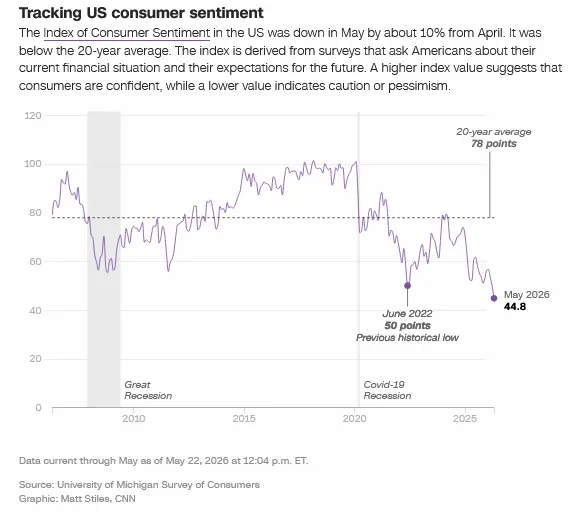 U.S. consumer sentiment fell to an all-time low in May, spurred by higher gas prices, inflation fears, waning business conditions, and increasing geopolitical risks. The 44.8 reading is the lowest survey result since tracking began back in 1952 and reflects an American public that is being squeezed from all sides.
“The cost of living continues to be a first-order concern, with 57% of consumers spontaneously mentioning that high prices were eroding their personal finances, up from 50% last month … Year-ahead inflation expectations inched up from 4.7% last month to 4.8% this month. The current reading substantially exceeds the 3.4% reading seen in February 2026 prior to the start of the Iran conflict, along with all 2024 readings.”[1]
There’s no doubt that Americans are anxious not only about the rising cost-of-living, but the fragility of the economy looking forward and the fate of their personal finances.
According to the chief economist at FwdBonds,
“The American consumer is treading water here, and the income tax refunds must be gone already or the money spent on the higher prices seen everywhere in the economy. The stock market record highs are having no effect whatsoever on cheering consumers up which means most Americans have the money locked up in 401K retirement accounts that cannot be drawn on to make life easier now.”[2]
Americans are not only grappling with high prices, but with systemic economic fatigue. Despite records on Wall Street, they remain cash-strapped by spiraling costs that are keeping them under water and over leveraged. This is not only crippling to U.S. households but endangering the broader economy — lest we forget that consumer spending is the single biggest driver of GDP.
America’s Economic Engine is Sputtering
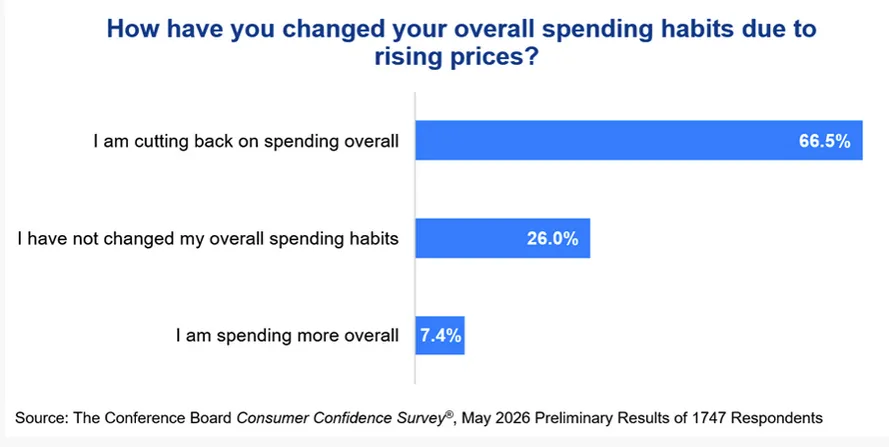
When U.S. consumers feel financially stressed and pull back on spending, the ripple effect touches nearly every key economic segment including jobs, the housing market and Wall Street. This isn’t just about empty shopping malls and fewer big-ticket purchases; it’s about the erosion of the engine that powers the American economy.
“Consumer spending remains the backbone of the economy accounting for approximately two-thirds of total economic activity. That scale gives household spending a powerful role in shaping U.S. economic growth, and investor confidence. When consumers keep participating in the economy, whether through purchases of everyday necessities like food or shelter or extras like travel and entertainment, they help sustain expansion even as other parts of the economy may cool.”[3]
Mounting bills, rising credit card debt, and shrinking savings are crushing consumer confidence resulting in frugality. This is more than a psychological shift — it’s a financial warning sign with serious economic consequences.
When consumers pull back on the purse strings, the dominoes fall quickly: investments slow, corporate profits weaken, business growth stalls, and layoffs follow. Since consumer behavior is the primary driver of economic activity, waning confidence matters. And with the latest consumer data pointing to a sharp deterioration in sentiment, the question is no longer whether consumer stress has economic consequences, but how deep those consequences will run.
Main Street is on the Brink
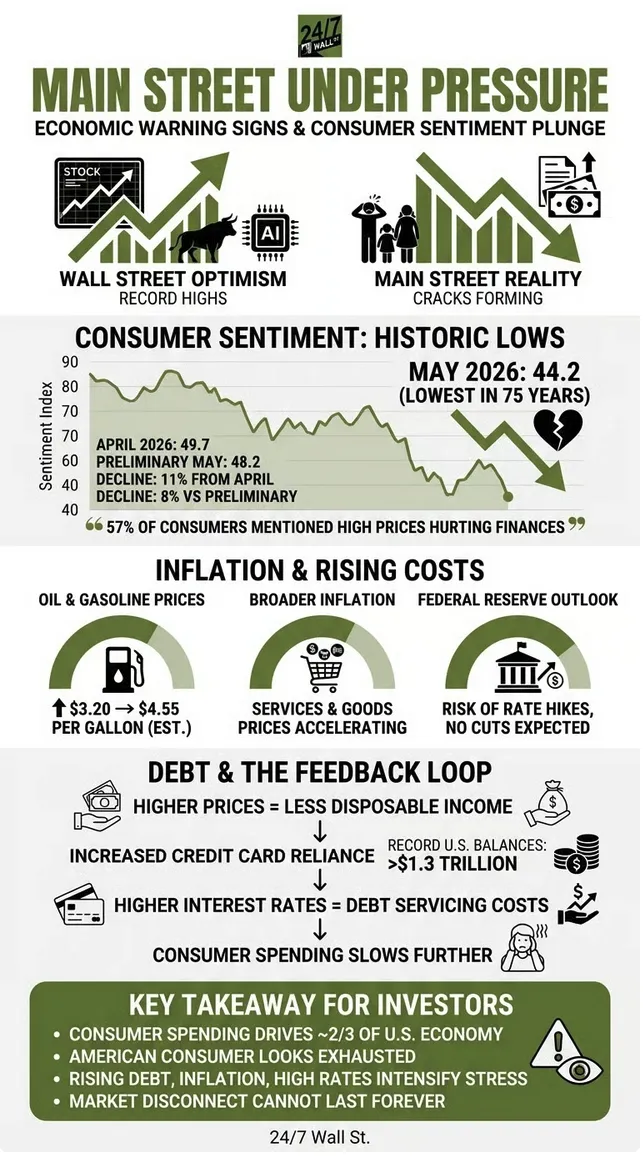 Welcome to the self-fulfilling ‘contraction cycle’ of the U.S. consumer: when Americans are financially stressed, the economy feels the strain. When household confidence weakens, economic momentum wanes. And when consumers retreat financially, the broader economy feels the impact.
Unlike large businesses and corporations, U.S. consumers confront the daily pain of soaring housing costs and surging energy bills. And despite Wall Street’s strong bull run, it is Main Street that is sounding the alarm about the deterioration of economic conditions.
According to 24/7 Wall Street, the latest consumer sentiment readings are a clear ‘flash recession’ warning:
“For months, Wall Street has tried to look past the cracks forming in the U.S. economy. The stock market keeps climbing, AI stocks keep printing new highs, and headline GDP figures still suggest growth. But Main Street is telling a very different story. Consumers are getting squeezed from every angle — rising inflation, higher gasoline prices, swelling credit card balances, and the growing risk the Federal Reserve may raise interest rates again instead of cutting them.”[4]
All of this raises the prospect of a looming downturn. Major financial institutions have recently placed the probability of a recession at between 40% and 60%, underscoring growing concern about the direction of the U.S. economy. Recession forecasting is notoriously difficult, of course, and in most cases, economists only recognize a recession after it has already begun.[5]
The Warning in the Data

When sentiment weakens and recession fears intensify, investors tend to gravitate toward defensive assets like gold. Gold has long been viewed as a trusted store of value for diversification and wealth preservation — and rising demand typically supports higher prices.
Because the U.S. economy depends heavily on buying, spending, and financial optimism … consumer burn out and inflation fatigue are a clear warning … and investors should ignore them at their own risk.
ORION METAL EXCHANGE is a top-rated
GOLD IRA DEALER with Best-in-Class CUSTOMER SERVICE.
Call for a FREE Investor Kit and up to $30K in FREE metals (on qualifying purchases).
REPRESENTATIVES ARE AVAILABLE NOW AT: 1-800-559-0088
1 https://www.sca.isr.umich.edu/
2 https://www.cnn.com/2026/05/22/economy/consumer-sentiment-final-may
3 https://www.usbank.com/investing/financial-perspectives/market-news/consumer-spending.html
4 https://247wallst.com/investing/2026/05/22/consumers-flash-recession-warning-as-trump-economy-sentiment-implodes/
5 https://www.reuters.com/markets/jpmorgan-lifts-global-recession-odds-60-us-tariffs-stoke-fears-2025-04-04/?