

When it comes to planning, President Dwight D. Eisenhower had a saying that’s worth repeating. Back in 1957, in remarks to the National Defense Executive Reserve Conference, he said, “Plans are worthless, but planning is everything.”[1]
At the time, the Cold War with the Soviet Union was reaching a critical juncture. The Soviets had just launched Sputnik, the world’s first artificial satellite, challenging U.S. technological superiority and shaking American confidence.
 Eisenhower was addressing the uncertainties of his time but nearly 70 years later, his words are remarkably relevant. The current conflict with Iran and technological war with China demonstrate how global events can disrupt financial markets, drive up consumer costs, and create new threats to our economic security.
The takeaway is clear: we cannot predict every crisis, but we can actively prepare for the unexpected.
The same principle applies to retirement. Even the most carefully constructed retirement plans make assumptions about stock returns, inflation, interest rates, longevity, healthcare costs and the solvency of programs like Social Security and Medicare.
But assumptions are not guarantees. Some will prove accurate. Others may not. That makes the act of planning important and having a Plan B more important than ever.
Wall Street is Unpredictable
Many retirees rely on stock values and dividends for income and since Wall Street can be volatile, this can be a risky proposition. In weak market conditions, investments can be sold at a loss and quickly deplete account values. This can be particularly damaging early in retirement when a down market can quickly erode savings.
According to Charles Schwab, something called the ‘sequence of returns risk’ can drain nest eggs and undermine the long-term financial security of younger retirees.
“Experiencing a market drop in the early years of retirement can create problems that go beyond the immediate hit to your portfolio—potentially to the point where your portfolio may not last as long as you need. That could prove catastrophic.”[2]
So, a retirement plan that depends heavily on Wall Street can be vulnerable to market corrections at precisely the wrong time. This can shrink your savings and dramatically increase the risk of outliving your money.
But market volatility isn’t the only threat to your retirement holdings. Even when markets cooperate, inflation can steadily erode the purchasing power of your money.
Inflation Can Blow Up Your Retirement Budget
Inflation has been called a hidden tax, a silent thief, and a quiet wealth killer. For retirees living on a fixed income, the impact of higher costs can be especially severe. Your income stays the same while what your distributions and withdrawals can buy … steadily and sometimes dramatically decrease.
According to one financial planner, inflation may not be as loud as market corrections, but it’s more stealth and arguably more damaging over time.
“Inflation does not usually feel like a crisis in any single year. Groceries cost a little more. Insurance premiums creep higher. Property taxes, utilities, travel, home repairs, and healthcare expenses gradually increase. None of those increases may seem dramatic by themselves. But over a 20-, 25-, or 30-year retirement, inflation can become one of the most persistent and destructive threats to your financial plan.”[3]
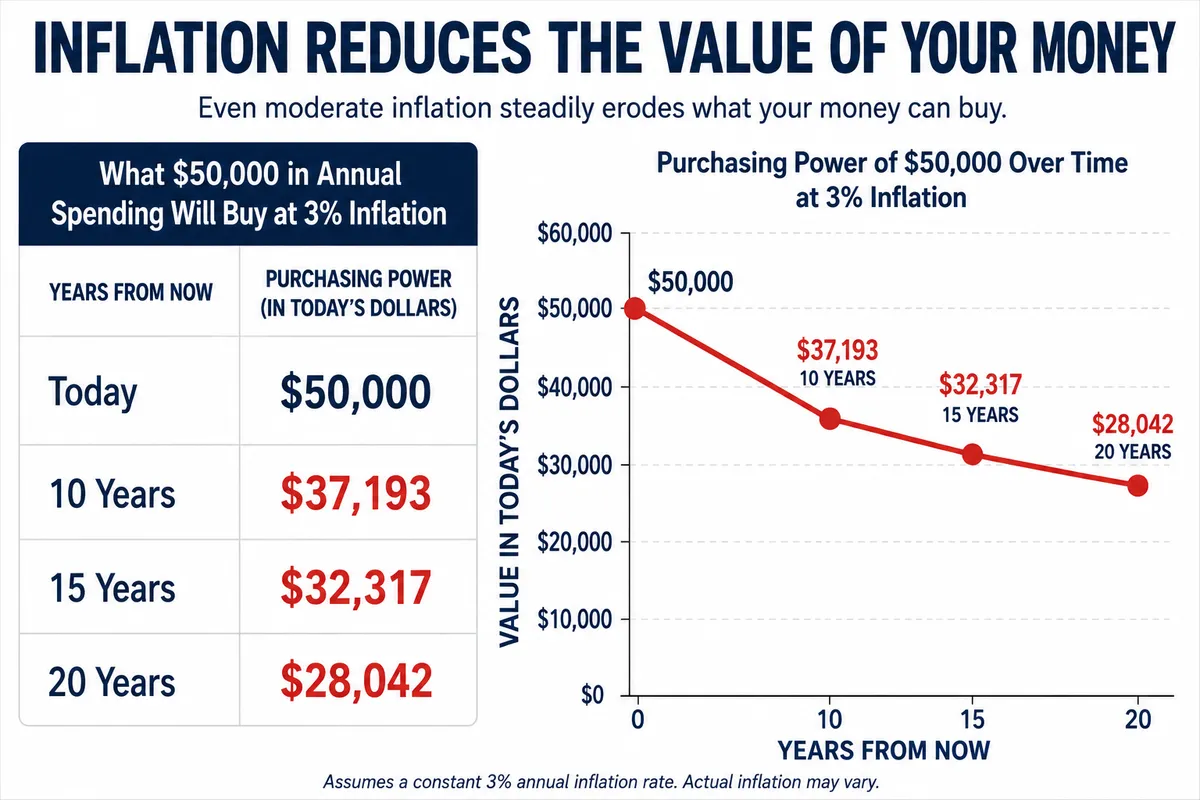
Think about it. You have no monthly salary. No raises, no bonuses, no medical coverage and all of a sudden, the cost of food is higher, gas goes up, healthcare co-pays surge, and housing costs skyrocket.
The rock-solid retirement plan that you thought you had carefully mapped out to keep you comfortable into your later years could run out of money much sooner than you thought. This is a reminder that retirement plan estimates and projections don’t necessarily hold forever particularly when it comes to the rising cost of living.
Yes, You Could Outlive Your Money
“You can be young without money but you can’t be old without it.”
Tennessee Williams
We all hope to live a long life, but longevity can actually be a mixed blessing. Advances in modern medicine have extended our lifespans, while today’s economic realities have made financing those extra years increasingly challenging.
 Scraping by in our later years is by far the biggest fear among today’s retirees. According to a recent USA Today feature, “Americans are less concerned about dying and more perturbed by the financial implications of remaining alive.”[4]
The article cites the key findings of a recent Allianz Life study that suggests that surging costs, rising economic uncertainty, and a lack of written retirement plans has pushed the fear of running out of money to record highs.
- 67% worry more about running out of money than death
- 48% do not have a written financial plan
- 57% feel anxious about their future financial well-being when their retirement accounts suffer a loss due to a market drop[5]
Today, living longer requires more than a traditional retirement plan. It often necessitates a flexible wealth strategy that accounts for the rising expenses that occur later in life. Living 20 or 25 years beyond retirement means decades of fixed income will come face to face with unknown costs.
The bottom line is … longevity creates financial risk and a fixed income portfolio that lasts decades leaves more time for market pullbacks, inflation, healthcare costs and other unplanned expenses to chip away at your retirement dollars. That’s why modern retirement planning must account for not only what you’ve saved but for how long that money should last.
The Eggs in One Basket Warning
“It is the part of a wise man to keep himself to-day for to-morrow, and not to venture all his eggs in one basket.” Miguel de Cervantes, Don Quixote
 The visual is quite simple. If all your eggs are in one basket and that basket drops, slips or fails … the eggs will likely break. The translation for retirement is to never invest all of your money in one plan, place, investment or set of assumptions.
Today’s retirement programs must account for unforeseen economic events, rising costs, surprise expenses, and possibly living longer than you ever thought you would. In other words, a retirement plan with no margin for error or room for the unexpected is not much of a safety net.
That’s why diversification matters. Holding different assets can help spread risk, particularly when economic conditions change without warning. For generations, gold, silver and platinum have been used as portfolio diversifiers. They are tangible assets that have historically behaved differently than Wall Street, inflation rates, the falling value of the dollar, and increasing economic and geopolitical volatility.
The bottom line is retirement rarely goes according to plan, and a lot can happen in the years after you stop working. Rising food prices, transportation costs, healthcare expenses, home repairs, and long-term care are just a few of the variables. So, having a Plan B isn’t about predicting disaster. It’s about building a retirement that can adapt to the unexpected.
A truly resilient retirement doesn’t depend on everything going right.
It’s designed to withstand the times when some things inevitably go wrong.
ORION METAL EXCHANGE is a Leading Precious Metals Dealer
With Live Pricing, Low Commissions and Top-Rated CUSTOMER SERVICE.
Call Now for a FREE Investor Kit!
REPRESENTATIVES ARE AVAILABLE NOW AT: 1-800-559-0088
1 https://www.eisenhowerlibrary.gov/eisenhowers/quotes?
2 https://www.schwab.com/learn/story/timing-matters-understanding-sequence-returns-risk
3 https://www.windingtrailfinancial.com/blog/inflation-risk-in-retirement
4 https://www.usatoday.com/story/money/personalfinance/2026/07/12/retirement-fears-outliving-savings-death/90873636007/
5 https://www.allianzlife.com/about/newsroom/2026-Press-Releases/Fear-Of-Running-Out-of-Money-Over-Death-At-Record-High