
On the surface, commodity exchange-traded funds (ETFs) appear to be a convenient way to invest in energy, agriculture, precious metals, and other hard assets. But despite their popularity, these funds are not always direct investments in the commodities themselves. In many cases, they are paper-based vehicles with structural risks that can limit diversification, distort performance, and behave very differently than the oil, corn or gold prices they’re designed to track.
While not exactly a wolf in sheep’s clothing, these vehicles can be misleading and introduce hidden costs, systemic risks, and market volatility that take many investors by surprise.
Types of Commodity ETFs
There are three types of commodity ETFs and they all differ with respect to how they trade, how they relate to spot prices, and what they hold (or don’t hold):
- Physically Backed
A physically backed ETF physically holds the commodity or commodities it trades. For example, a physically backed ETF that invests in precious metals may store gold, silver, platinum, or palladium bars in a secure vault at a bank.
- Futures-Based
Futures-based ETFs invest in commodities futures contracts, rather than holding or storing physical commodities. That can reduce the overall management costs, resulting in lower expense ratios for investors.
- Commodity Company
Commodity company ETFs invest in companies that produce or process commodities. For example, this type of ETF may invest in oil and gas companies, cattle farming operations, or companies that operate palm oil plantations.[1]
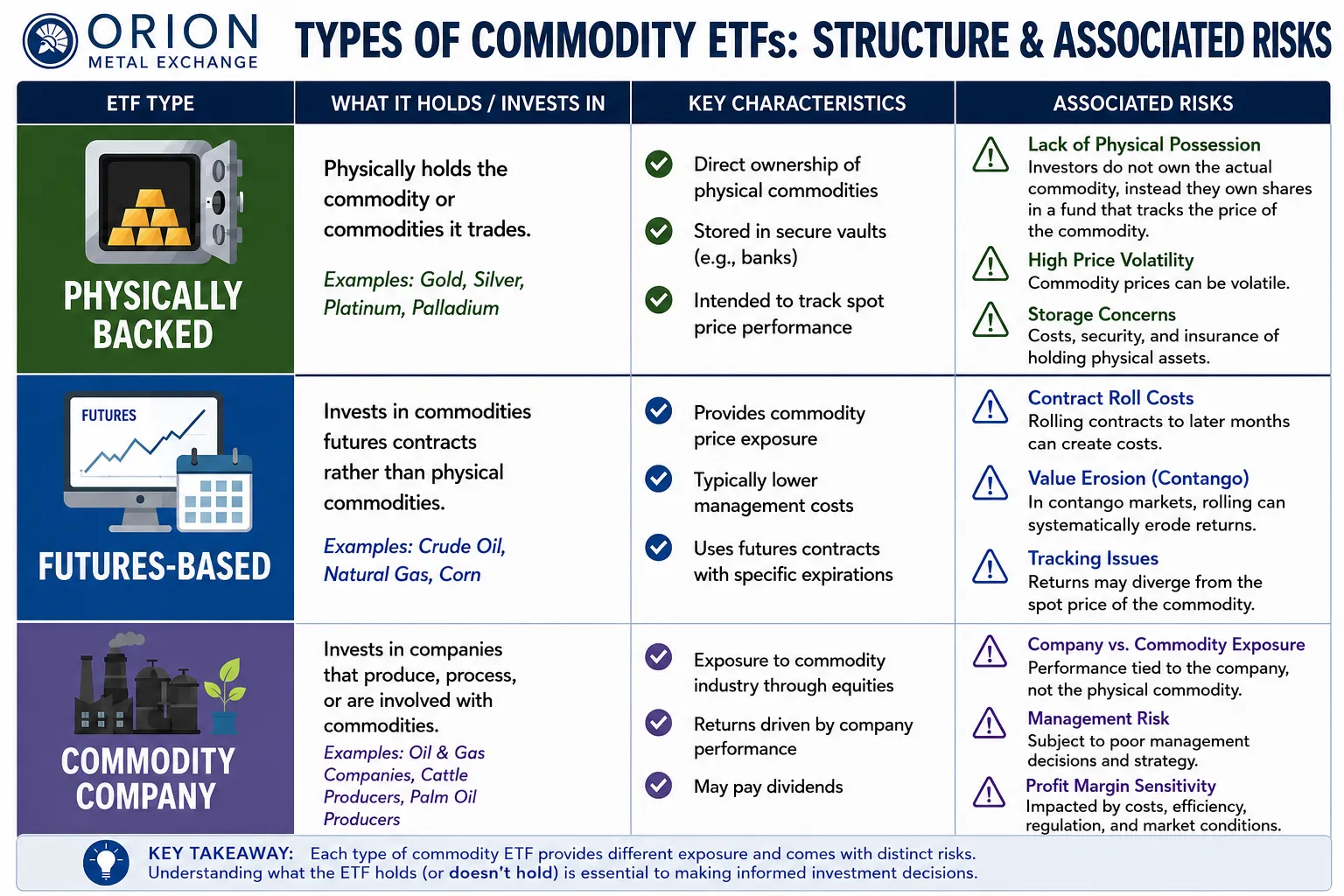
All of these ETFs carry distinct risks. Physically-backed can be exposed to high price volatility, storage concerns, and illiquidity. Futures-Backed are subject to contract roll costs, value erosion, and tracking issues. Commodity Company ETFs track the strength of a company as opposed to the physical asset itself leaving your money subject to management risks.
So, while commodity ETFs are often grouped together as a single asset class, each type has its own set of tradeoffs.
Understanding what an ETF actually owns or doesn’t own, does or does not do, and how it generates its returns … is critical before deciding to invest in one.
This is particularly true for futures-based ETFs, where a phenomenon known as “contango” can erode returns over time, even when the underlying commodity is rising in value.
The ‘Contango Effect’
While it sounds like an exotic Spanish dance, “contango” is actually a market condition that results in a “sell low and buy high” cycle, and it can be a portfolio killer.
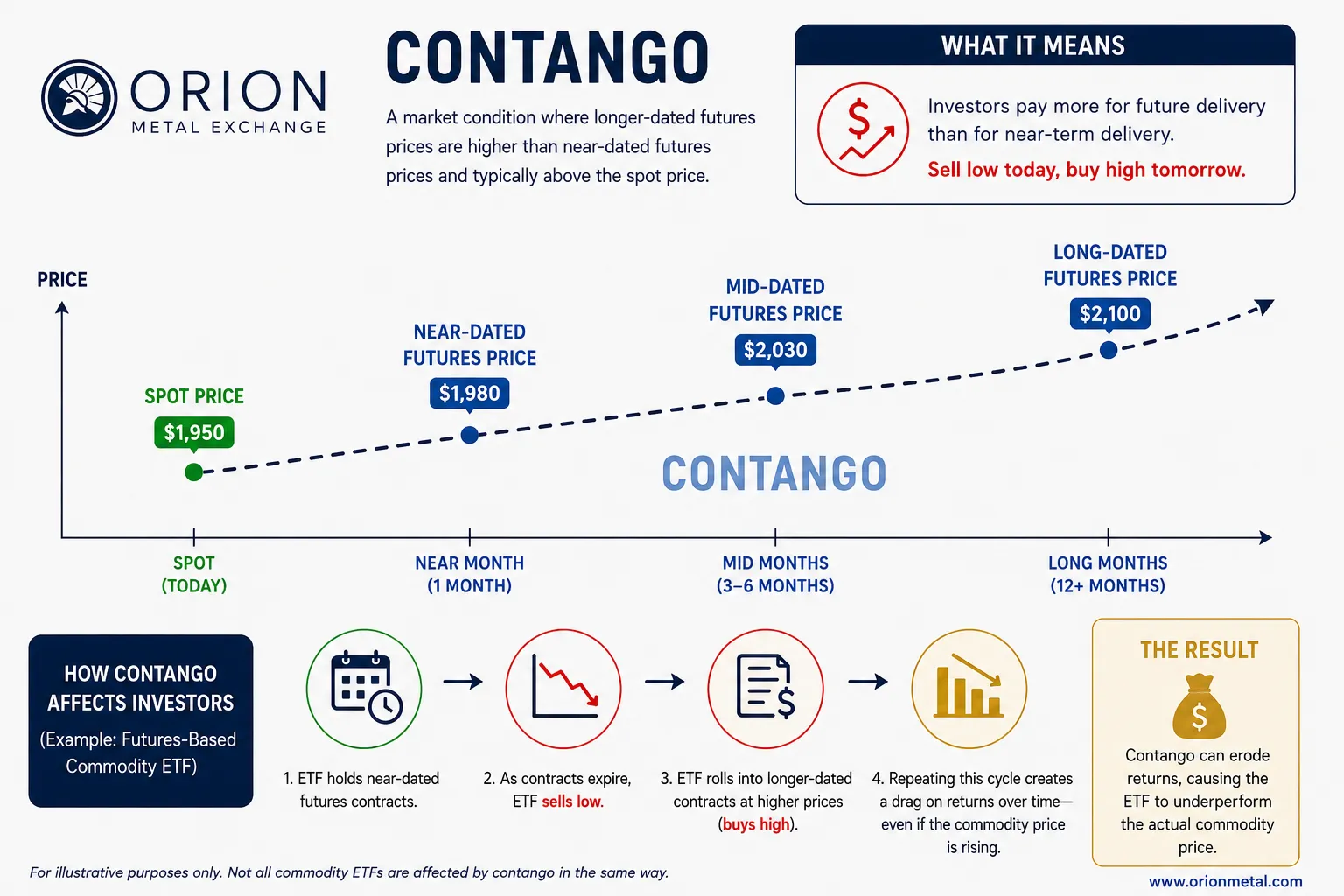
According to global financial services firm EBC Financial Group, when a commodity ETF underperforms the raw price of oil, gold, or natural gas, contango is often the underlying cause. It happens when longer-dated futures contracts trade at higher prices than near-dated contracts and typically above the commodity’s current spot price:
- Contango is a normal and well-documented market condition in futures trading.
- It occurs when futures prices are higher than spot prices, creating an upward-sloping futures curve.
- Storage costs, financing charges, and market expectations are the primary drivers behind contango.
- It can quietly erode returns for futures-based ETF investors through a process known as negative roll yield.
- Understanding contango is essential for anyone trading commodities, energy contracts, or futures-linked investment products.[2]
For those investors who thought they had found an easy and inexpensive way to buy into gold for instance, the contango effect comes as a rude awakening because while the price of gold may be rising, a futures-based ETF can rapidly lose value. As the ETF sells lower-priced contracts for higher prices ones, returns can be negatively impacted creating a significant gap between the performance of the ETF and the performance of gold itself.
So, whether it’s paper-backed exposure, rolling contracts, or management risks … the lesson is clear: before putting money into a commodity ETF, know exactly what you’re buying.
Understand What You Own
 The real challenge with Commodity ETFs isn’t the strength of the commodity itself. There are compelling reasons to invest in oil, natural gas, wheat, soybeans and of course gold. The problem is that investors often focus solely on the asset while overlooking the mechanics of how the investment works.
For instance, gold stocks, gold mining stocks, and gold ETFs can behave differently. And in the case of some Gold ETFs, they can behave ‘very’ differently.
“Gold ETFs are liquid, you can buy/sell them anytime the market is open. They’re also low-maintenance … However, ETFs come with some trade-offs. You’re not actually holding the metal. You’re relying on a fund to do that for you. That means there’s some level of trust involved. Also, most ETFs charge small management fees that, over the long term, can take commission from your returns … One other note, owning physical gold gives you something solid. It’s not just a number on a screen. You have real, tangible wealth that isn’t tied to any digital system or third party. This can be powerful in times of extreme financial uncertainty or when you want to pass something of lasting value down to future generations.”[3]
So, if the gold is not in the form of a physical coin or bar that you can touch, hold and feel … it’s important to determine how it generates returns both short-term and long-term.
With respect to Gold ETFs in particular, they come with added costs and considerations that can impact performance. In addition to annual management fees, investors must rely on a network of financial institutions responsible for holding, administering, and safeguarding the gold.
“Gold ETFs often carry an expense ratio and additional fees, which can affect investors’ returns. These costs are associated with managing and administering the ETF, including activities like tracking gold prices and providing liquidity to investors …Investing in Gold ETFs [also] comes with a level of counterparty risk. The value of Gold ETFs is tied to the financial institutions that support them and their ability to hold physical gold. Investors could incur losses if the institution faces financial challenges or fails to meet its obligations. Prior to investing, it’s important to consider the reputation and stability of the financial institution backing the Gold ETF.”[4]
Suffice to say, one of the most erroneous assumptions investors can make about Commodity ETFs is believing they own the asset itself simply because they invested in something like it or linked to it. In reality, these are financial products with their own costs, mechanics, and risks. And while they may track the performance of a commodity, factors such as market volatility, supply-and-demand imbalances, fund expenses, liquidity challenges, and structural risks can cause ETF returns to diverge from the very asset they’re intended to represent.
Commodity ETFs can play a role in a diversified portfolio, but it’s important to know precisely what the fund owns, how it generates returns, and what risks may be hidden beneath the surface … because the investment isn’t always what you think it is.
ORION METAL EXCHANGE is a Leading Precious Metals Dealer
With Live Pricing, Low Commissions and Top-Rated CUSTOMER SERVICE.
Call Now for a FREE Investor Kit!
REPRESENTATIVES ARE AVAILABLE NOW AT: 1-800-559-0088
1 https://www.sofi.com/learn/content/commodity-etf/
2 https://www.ebc.com/forex/what-is-contango-in-trading-and-why-did-it-happen
3 https://cfi.ps/en/educational-articles/introduction-to-financial-markets/gold-etfs-vs-physical-gold-a-complete-guide-for-new-investors
4 https://www.cmcinvest.com/en-sg/learn/the-advantages-and-disadvantages-of-gold-etfs-versus-physical-gold