Have you noticed? Home sales have slowed, buyers are sitting on the sidelines, and many homeowners, particularly Baby Boomers, are locked into historically low mortgage rates. Residential America has become a frozen tundra of stalled transactions, reluctant sellers, and would-be buyers waiting for a thaw.
The result is a housing market on ice. Buyers are desperately waiting for rates to fall. Sellers are unwilling to list. Inventory remains tight, demand has weakened, and affordability continues to deteriorate. Is this a real estate story or an early warning sign of broader economic trouble ahead?
Reluctant Nesters
At the forefront of the current real estate slump is the curious case of Baby Boomers and Gen Xers. Scores of older Americans re-financed their mortgages during the historically low rates of the Covid-19 era. Some have enjoyed some of the lowest mortgage payments of their lives while their property values have skyrocketed.
 While they may no longer need or want a four-bedroom house, downsizing could come with a massive tax bill if they sell their residence for substantially more than they paid for it. A survey last year revealed that as many as 61% of boomers are staying put.[1]
“Because home prices have appreciated so much since then, many long-term homeowners now face a tax hit on their profits if they sell. The median home price has risen from $129,000 in 1997 to $419,300 today. The bigger their profit on the sale, the higher the tax bill when they do sell. And the situation further complicates a market already facing a housing shortage of millions of units.”[2]
This “rate-lock” trap is creating a ripple effect across the economy. Older homeowners refuse to sell, fewer homes come to market, and younger buyers face fewer opportunities to purchase.
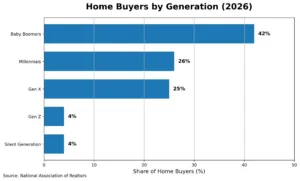 The result is a housing market that is immobilized. And because housing has historically been a leading indicator of economic activity, investors must consider whether this deep freeze is a warning sign of slower growth ahead. Baby boomers remain by far, the largest generational home owners in the United States and first-time home buyers have now fallen to a record low.[3]
Housing and GDP
Housing is a vital sector of the American economy. Home ownership is not only a cornerstone of the American Dream, but it directly contributes to GDP.
According to the National Association of Home Builders, residential investment and consumption spending on housing services contribute between 15% to 18% to GDP annually … about one-sixth of the U.S. economy.[4]
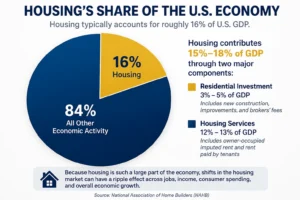 That contribution is reflected in lending, taxes, insurance, utilities, moving expenses, furnishings, maintenance, repairs, appliances, etc.
According to the Royal Bank, the U.S. Housing Market remains icebound as home sales are now lower than during the depths of the Global Financial Crisis.
“The primary issue is affordability, driven by (relatively) high mortgage rates and a lack of supply. The supply story is two-fold. For existing home sales, the significant gap between the average 30-year fixed mortgage rate (currently above 6%), and the incredibly low post-pandemic rates that many homeowners locked in has kept inventory suppressed. After all, how many homeowners would want to leave a sub-3% mortgage? At the same time, higher rates and inflation have weighed on homebuilders, limiting the supply of new homes on the market. Lack of supply has contributed to home prices rising over the past several years, despite the typical inverse relationship with mortgage rates.”[5]
This prolonged slowdown in housing has implications that extend far beyond the real estate market. When home sales stall, fewer dollars flow through home building, improvement, loans, and countless related industries, creating a measurable drag on economic growth. And, the last time one of America’s largest economic engines froze and cracked, investors sought refuge in gold.
Economic Headwinds and Gold
If the housing market is becoming unstable, gold will be a likely beneficiary since it has a low correlation to real estate and/or Wall Street. It’s not only considered a safe haven but in the event of another residential real estate meltdown or broader paper asset collapse, history suggests that it will retain its value.
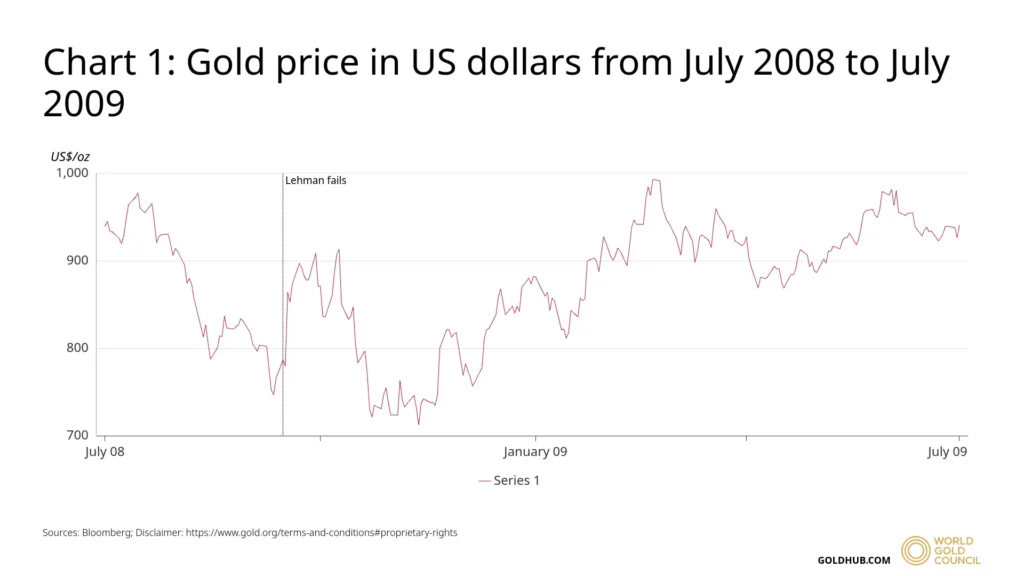 Gold is an independent asset that is typically unaffected by credit risks, defaults, foreclosures, short sales, bank stability, or the intricacies of housing supply and demand. While gold initially fell during the start of the subprime crisis in 2008, mainly due to liquidation — it went on a robust bull run over the next two years and ultimately hit record highs by 2011.
“A crisis-driven major move into gold usually occurs only when investors and savers start to look for alternatives to the US dollar, fueled by fears of US dollar weakness, inflation or about the very fabric of the financial system. And that is exactly what happened following the Great Financial Crisis (GFC). By March 2009, gold was comfortably above its pre-crisis level and went on to make strong gains throughout the second half of 2009, 2010 and most of 2011.This was not just a consequence of the US dollar weakening. Investors and speculators were also expressing their concerns about the consequences of quantitative easing and other radical monetary policy moves of that time.”[6]
While a frozen housing market does not necessarily signal an imminent financial crisis, it does suggest that pressure is building within one of the economy’s most influential sectors. Many older Americans remain locked into low-rate mortgages, inventory remains constrained, and home prices continue to hover near record highs. The result is a stifled market that restricts mobility, suppresses transactions, and creates a growing drag on GDP.
History suggests that when housing shifts from an economic tailwind to an economic headwind, investors begin looking elsewhere for stability and wealth preservation. More often than not, they have found it in gold and other precious metals.
ORION METAL EXCHANGE is a Top-Rated Precious Metals Dealer
With Live Pricing, Low Commissions and Best-in-Class CUSTOMER SERVICE.
Call for a FREE Investor Kit and up to $30K in FREE metals (on qualifying purchases).
REPRESENTATIVES ARE AVAILABLE NOW AT: 1-800-559-0088
1 https://www.msn.com/en-us/news/insight/rising-costs-and-taxes-make-retirement-downsizing-less-appealing/gm-GM10CE9FA8?
2 https://www.realtor.com/news/real-estate-news/capital-gains-tax-exclusion-malliotakis-nest-egg-protection-act/
3 https://www.nar.realtor/newsroom/baby-boomers-remain-largest-share-of-home-buyers-as-first-time-buying-falls-to-record-low
4 https://www.nahb.org/news-and-economics/housing-economics/housings-economic-impact/housings-contribution-to-gross-domestic-product
5 https://www.rbc.com/en/economics/us-analysis/us-featured-analysis/us-housing-market-the-deep-freeze-continues/
6 https://www.gold.org/goldhub/research/gold-investor/gold-investor-february-2019/13643